
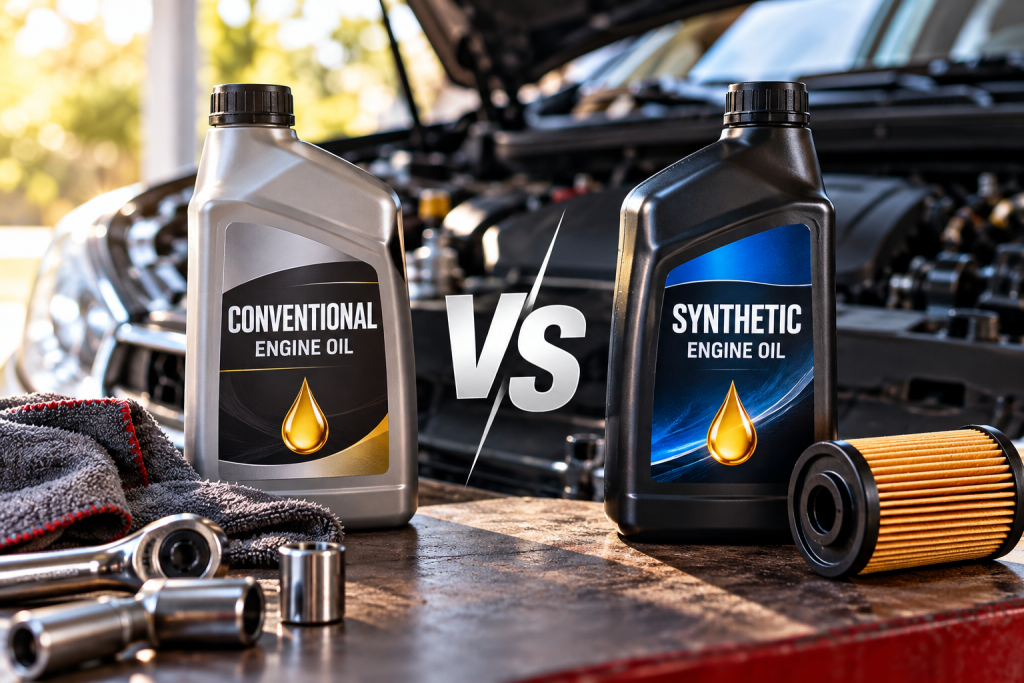
Walk into any auto parts store and the oil aisle can feel overwhelming. Conventional, synthetic blend, full synthetic, high mileage, and a long list of numbers and letters on every bottle. Each label promises better protection, and each one raises the same question. Which oil is actually right for your car? The answer matters, because engine oil does far more than most drivers realize, and the wrong choice can affect performance, wear, and in some cases a warranty. This guide explains the difference between synthetic and conventional oil, what the labels mean, how to choose, and how a mobile oil change in Raleigh can take care of it without a trip to a shop.
What Does Engine Oil Actually Do?
Inside your engine, metal parts move against each other thousands of times a minute. Oil forms a thin protective film between them so they glide instead of grind. It also carries heat away from hot spots, helps keep the engine clean by holding tiny particles and deposits in suspension, protects against rust and corrosion, and helps seal the gap between pistons and cylinder walls. Over time, oil breaks down from heat and picks up contaminants, which is why it needs to be changed. Using the right oil and changing it on schedule is one of the simplest and most effective ways to protect an engine.
What Is Conventional Oil?
Conventional oil is refined from crude petroleum. It has been used in engines for a very long time, and it provides adequate protection for many vehicles under normal driving conditions. Because it is refined from a natural source, its molecules vary in size and shape, and it tends to break down faster under high heat and heavy stress than synthetic oil. Many manufacturers still approve conventional oil for certain engines, particularly simpler or older designs, and it often costs less per change than synthetic.
What Is Synthetic Oil?
Synthetic oil is engineered in a laboratory. Instead of relying on the natural mix of molecules found in crude oil, it is built from more uniform base oils and a carefully designed set of additives. That uniformity gives it several advantages. It generally flows better at low temperatures, resists breaking down at high temperatures, forms fewer deposits and sludge, and keeps its protective qualities longer. Many modern engines, especially turbocharged and direct injection designs, run hotter and tighter, and manufacturers increasingly specify synthetic oil for them.
What About Synthetic Blend Oil?
A synthetic blend mixes conventional and synthetic base oils. It is meant to deliver some of the benefits of synthetic, such as improved resistance to heat and better low temperature flow, at a price between the two. How much benefit you get depends on the product and the proportion of synthetic oil used. A blend can be a reasonable middle choice for vehicles whose manufacturer allows it, but if your manual calls for full synthetic, a blend is not a substitute.
What Is High Mileage Oil?
High mileage oils are made for engines that have been on the road a long time. They typically contain additives that condition seals, which can shrink and harden with age, and extra detergents or anti wear ingredients. They come in conventional, blend, and synthetic versions. They can be a good fit for an older engine that is not leaking or burning oil badly, but they are not a cure for a serious problem. Check your owner’s manual and ask a technician whether it makes sense for your vehicle.
How Do They Compare?
- Protection at high temperatures: synthetic oils are generally designed to hold up better when the engine runs hot
- Cold weather flow: synthetic oils generally flow more easily when the engine is cold, which reduces wear during startup
- Deposits and sludge: synthetic oils tend to resist breaking down into sludge, which helps keep the engine cleaner
- Change interval: some synthetic oils support longer intervals, but the right interval depends on your vehicle and driving, so follow your manual
- Cost per change: synthetic oil often costs more per change than conventional, though a longer interval can offset part of that for some drivers
- Availability of approval: some engines require synthetic, while others allow a choice
How to Read the Numbers on the Bottle
The most visible number is the viscosity grade, such as the pair of numbers separated by the letter W. The first number, followed by the W, which stands for winter, describes how the oil flows when cold. A lower number means the oil flows more easily in cold conditions. The second number describes how thick the oil is at normal operating temperature. Using the viscosity your manufacturer specifies matters, because engines are built with tight clearances that depend on the right flow characteristics. You may also see service ratings or certification marks that indicate the oil meets industry performance standards. Your owner’s manual lists the viscosity and the standards your engine requires, and it is the best source for what to use.
How Do I Choose the Right Oil?
- Start with your owner’s manual, which lists the required viscosity, the performance standard, and whether synthetic is required
- Check the oil filler cap or the label under the hood, which often shows the viscosity
- If your car is under warranty, follow the manufacturer’s specification to avoid problems
- Think about how you drive, since towing, short trips, extreme heat, and stop and go traffic are harder on oil
- Ask a technician if you are unsure, especially for older or high mileage vehicles
If your manual calls for synthetic oil, use synthetic. If it allows a choice, the decision depends on your driving, your budget, and how long you plan to keep the car. Using a better oil than the minimum is usually safe as long as it meets the required viscosity and standard.
Does Raleigh Driving Affect Which Oil to Use?
It can. Heavy traffic, frequent stops, and short commutes are hard on oil, because the engine may not stay hot long enough to burn off moisture and fuel that collect in the oil. Hot, humid summers add heat stress. Our article on growing pains and what Raleigh’s traffic boom means for car upkeep explains how congestion affects your vehicle, and oil is one of the first things to feel it. Many manuals list a severe service schedule for these conditions, with shorter change intervals. A synthetic oil can offer extra margin for demanding driving, but the schedule in your manual still comes first.
Common Myths About Oil
Myth: Once You Switch to Synthetic, You Cannot Go Back
This is not true. You can switch between oil types as long as you use the viscosity and standard your engine calls for. The idea may have come from older concerns that no longer apply to modern oils.
Myth: Synthetic Oil Causes Leaks
Synthetic oil does not cause leaks by itself. Sometimes an older engine with worn seals starts to show a leak after a switch, because the cleaner oil or its flow reveals a seal that was already weak. The seal was the problem, not the oil.
Myth: Thicker Oil Is Always Better
Thicker oil is not automatically more protective. An oil that is too thick for your engine can flow slowly on startup and reduce efficiency. Use the viscosity your manufacturer specifies.
Myth: Oil Only Needs to Be Changed When It Looks Dirty
Color alone is not a reliable guide. Oil can darken quickly as it cleans the engine, and it can lose its protective qualities while still looking fine. Follow the interval in your manual and any oil life monitor your car has.
Signs Your Oil Needs Attention
- The oil change reminder or oil life monitor says it is time
- The oil pressure or oil level warning light comes on
- Dark, gritty, or sludgy oil on the dipstick
- A low oil level, which can mean a leak or oil consumption
- A burning oil smell or blue smoke from the exhaust
- Louder engine noise, such as ticking or knocking
- Oil spots under the car
If the oil pressure light comes on while you are driving, stop safely and turn off the engine, because running without enough oil can cause serious damage quickly. If your car will not start after a problem like that, our guide to the top 10 reasons your car won’t start and how to get back on the road covers other common causes.
What Happens During an Oil Change?
A proper oil change is more than draining and refilling. A technician typically warms the engine slightly, removes the drain plug and drains the old oil, replaces the oil filter, checks the drain plug and its washer, and refills with the correct amount and type of oil. They then check the level, look for leaks, reset the oil life monitor if the vehicle has one, and often do a quick look at other fluids, belts, hoses, and tires. Used oil and filters should be disposed of responsibly.
Can a Mobile Mechanic Do an Oil Change?
In many cases, yes. A mobile mechanic can come to your home or workplace in the Raleigh area, change the oil and filter with the type of oil your vehicle needs, and check the other fluids at the same time. That saves you a trip and a wait, and it lets you ask about oil types directly. Some vehicles have hard to reach filters, special procedures, or undercar shields that make the job harder to do on site, and a trustworthy technician will tell you honestly when that is the case. When you book, share your vehicle’s year, make, model, and mileage, along with the oil specification in your manual if you have it, so the right oil and filter are on hand.
Choosing With Confidence
The best oil for your car is the one your manufacturer specifies, changed on the schedule that fits how you drive. Synthetic oil offers real advantages for many engines, conventional oil still works for others, and blends fill the middle. If you are not sure, a quick conversation with a technician and a look at your owner’s manual can settle it.
To learn more about our services, visit our homepage. If you would like an oil change at your location, reach out through our contact us page and we will come to you anywhere in the Raleigh area.